4/30/09

Influenza: El que nombra primero...nombra dos veces.


raíz de que se desató la histeria e incertidumbre por la nueva influenza que aqueja al mundo (una mezcla genética de virus de influenza aviar, porcino y humano), también se desató una guerra por la nomenclatura del padecimiento. 

Dado que los primeros caso se dieron en México, con una concentración considerable en la Ciudad de México y su periferia, muchos se refieren a esta gripe como "la gripe Mexicana" ("the Mexican Flu"). Este fenómeno se ha dado sobre todo en Estados Unidos y Europa, aunque en Brasil se dice que la industria porcina ha discutido que el mejor nombre para este padecimiento sea "la gripe mexicana" ya que esta industria ha presentado considerables pérdidas porque ni siquiera el lobo quiere acercarse a los tres cochinitos ni para saludarlos de lejos, mucho menos consumir su carne. El cabildeo brasileño ha llegado incluso a la Organización Mundial de la Salud, ya que los industriales del puerco de Brasil, en voz de Pedro Camargo Nieto, le han recomendado a la mismísima Margaret Chan,  dejar de referirse a la gripe porcina y mejor darle el nombre azteca. Camargo ha dicho a Reuters que "no hay un sólo cerdo en México con esta gripe" ya que la transmisión es de humano a humano. 

Aún cuando también se ha confirmado por los expertos en salud que el contagio de esta gripe no ocurre por contacto con cerdos, ni por comer carnitas; a diferencia de la gripe aviar, que sí se transmite al comer o entablar relaciones amistosas con guajolotes o patos, la gente ha preferido extremar precauciones y no consumir cerdo. Esto por supuesto tiene a los industriales de este ramo muy preocupados por el nombre de la pandemia, y como dice le título del post: el que nombra primero, nombra dos veces. Para los industriales de la carne, es preferible que la gente se aleje de los mexicanos que de los cerdos, así es que se ha entablado una polémica considerable por el nombre de la peste. Al fin y al cabo, nadie consume carne de mexicanos ¿o sí?

En Estados Unidos hay gritos de alerta de algunos grupos antiinmigrantes (por supuesto!) llamados al cierre de la frontera y a la erradicación de todos los sospechosos de ser mexicanos, ilegales y por supuesto de traer la "gripe mexicana" a tan aseado país. Este tipo de discursos se han difundido sobre todo en la llamada "radio conservadora", con algunas voces bastante vitriólicas como Michael Savage, que ya construye toda una teoría conspiratoria de terrorismo a través de México. Por supuesto, se ha llamado a establecer restricciones para viajar a México, y también para cerrar la frontera. Como si el cierre físico de las fronteras detuviera al virus microscópico, o como si el estatus legal de las personas tuviera una relación directa con sus patologías virales. 

Sin embargo, las medidas sanitarias en Estados Unidos no reflejan las tomadas en México: aquí no se han cerrado escuelas, y ni siquiera se manda a casa a los alumnos que tienen una gripe fuerte. Lo que sí se ha hecho, es estar alerta a los llamados de la OMS y se han difundido campañas para extremar precauciones (como lavarse las manos, por ejemplo). 

Ante la desinformación y la zozobra, es muy fácil recurrir al arsenal de prejuicios que se tienen sobre los inmigrantes mexicanos para comenzar una vez más una cacería de brujas simbólica. Las estructuras de poder y de opresión, no se componen únicamente de políticas públicas, leyes o instituciones; generalmente éstas nacen de la representación simbólica que los individuos y los grupos sociales construyen día a día sobre un segmento de la población o respecto a un problema específico. La cultura, dicen los expertos, se forma con estas representaciónes cotidianas sobre la vida, se crea con la asignación agregada de  nombres y significados, por eso es tan poderosa la herramienta del nombrar.  

Los prejuicios están allí en el imaginario público, es fácil construir estas relaciones de catástrofe y temor y atribuirlas a los grupos marginales. Es fácil, y hasta reconfortante crear chivos expiatorios y sacrificarlos públicamente por el bien de "las mayorías". 

Esperemos que este asunto de las nomenclaturas no termine en una guerra de cabildeos de los llamados "grupos de interés" por el nombre de esta ya declarada pandemia y que no haya ni chivos ni puercos ni minorías expiatorios.
 
Antonieta Mercado
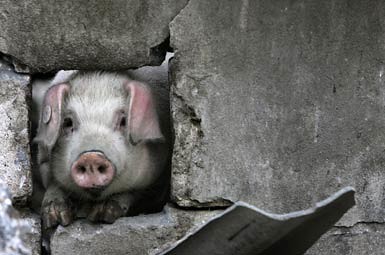

pig-in-earthquake by jingejinge.
Photo by Jin Ge


4/12/09

So Long Mom...I am off to drop the bomb!


This is a prophetic song by Tom Leher....very funny. What Leher said here in the video and in the explanation below, reminded me of that book by Chris Hedges: War is a force that gives us meaning. I wonder if people will remember the Iraq war a few years from now as "those great old times when everybody drove a Hummer and dressed with camouflaged clothing" even around Rodeo Drive or Disneyland! Very fashionable. 


Here Tom Leher words:

"This year we've been celebrating the hundredth anniversary of the Civil War and the fiftieth anniversary of the beginning of World War I and the twentieth anniversary of the end of World War II so all in all it's been a good year for the war buffs and a number of LPs and television specials have come out capitalizing on all this "nostalgia" with particular emphasis on the songs of the various wars. I feel that if any songs are going to come out of World War III we'd better start writing them now. I have one here. You might call it a bit of pre-nostalgia. This is the song that some of the boys sang as they went bravely of to World War III."

Tom Leher

So long, Mom,
I'm off to drop the bomb,
So don't wait up for me.
But while you swelter
Down there in your shelter,
You can see me
On your TV.

While we're attacking frontally,
Watch Brinkally and Huntally,
Describing contrapuntally
The cities we have lost.
No need for you to miss a minute
Of the agonizing holocaust. (Yeah!)

Little Johnny Jones he was a U.S. pilot,
And no shrinking vi'let was he.
He was mighty proud when World War Three was declared,
He wasn't scared,
No siree!

And this is what he said on
His way to Armageddon:

So long, Mom,
I'm off to drop the bomb,
So don't wait up for me.
But though I may roam,
I'll come back to my home,
Although it may be
A pile of debris.

Remember, Mommy,
I'm off to get a commie,
So send me a salami,
And try to smile somehow.
I'll look for you when the war is over,
An hour and a half from now! 


From: http://www.metrolyrics.com/so-long-mom-lyrics-tom-lehrer.html

4/7/09

Les Copains D´Abord


This is a song for my friends. 


Les copains d'abord

Non, ce n'était pas le radeau
De la Méduse, ce bateau
Qu'on se le dise au fond des ports
Dise au fond des ports
Il naviguait en pèr' peinard
Sur la grand-mare des canards
Et s'app'lait les Copains d'abord
Les Copains d'abord

Ses fluctuat nec mergitur
C'était pas d'la litterature
N'en déplaise aux jeteurs de sort
Aux jeteurs de sort
Son capitaine et ses mat'lots
N'étaient pas des enfants d'salauds
Mais des amis franco de port
Des copains d'abord

C'étaient pas des amis de luxe
Des petits Castor et Pollux
Des gens de Sodome et Gomorrhe
Sodome et Gomorrhe
C'étaient pas des amis choisis
Par Montaigne et La Boetie
Sur le ventre ils se tapaient fort
Les copains d'abord

C'étaient pas des anges non plus
L'Évangile, ils l'avaient pas lu
Mais ils s'aimaient tout's voil's dehors
Tout's voil's dehors
Jean, Pierre, Paul et compagnie
C'était leur seule litanie
Leur Credo, leur Confiteor,
Aux copains d'abord

Au moindre coup de Trafalgar
C'est l'amitié qui prenait l'quart
C'est elle qui leur montrait le nord
Leur montrait le nord
Et quand ils étaient en détresse
Qu'leurs bras lancaient des S.O.S.
On aurait dit les sémaphores
Les copains d'abord

Au rendez-vous des bons copains
Y avait pas souvent de lapins
Quand l'un d'entre eux manquait a bord
C'est qu'il était mort
Oui, mais jamais, au grand jamais
Son trou dans l'eau n'se refermait
Cent ans après, coquin de sort
Il manquait encore

Des bateaux j'en ai pris beaucoup
Mais le seul qu'ait tenu le coup
Qui n'ai jamais viré de bord
Mais viré de bord
Naviguait en père peinard
Sur la grand-mare des canards
Et s'app'lait les Copains d'abord
Les Copains d'abord


Los amigos primero

No, no es la balsa
De la Medusa, este barco (5)
Que se sepa en el fondo del puerto
Sepa en el fondo del puerto
Él navegaba tranquilamente (1)
Por encima del qué dirán
Y se llamaba los Amigos Primero
Los Amigos Primero

Sus fluctuat nec mergitur (2)
No eran literatura
No disgustaba a los hechiceros
A los hechiceros
Su capitán y sus marineros
No eran hijos de putas
Sino buenos amigos desinteresados
Antes que nada amigos

No eran amigos de lujo
Pequeños Castor y Pollux (3)
Gentes de Sodoma y Gomorra
Sodoma y Gomorra
No eran amigos elegidos
Por Montaigne y la Boetie (4)
En la barriga se daban buenas palmadas
Los amigos primero.

Tampoco eran ángeles
El evangelio no lo habían leído
Pero se querían a toda máquina
A toda máquina
Jean, Pierre, Paul y compañía
Era su unica letanía
Su Credo, su Confiteor
Para los amigos primero.

Al menor aviso de un Trafalgar
Era la amistad quien se ponía en guardia
Era ella quien les mostraba el norte
Les mostraba el norte
Y cuando estaban en apuros
y sus brazos lanzaban S.O.S.,
Parecían faros
Los amigos primero.

En las citas de los buenos amigos
No solía haber ausentes
Cuando uno de ellos no subía a bordo
Era porque había muerto.
Sí, pero nunca, nunca jamás,
Se cerraba su agujero en el agua
Cien años después, pillo con suerte,
Todavía faltaba.

Yo he tomado muchos barcos
Pero el único que ha aguantado
Que no ha cambiado de rumbo
Cambiado de rumbo
Navegaba tranquilamente
Por encima de qué dirán
Y se llamaba los Amigos Primero
Los amigos Primero

(1) Père peinard: Un père peinard es un hombre que gusta de vivir tranquilo y sin sobresaltos, se cuida y es apacible.
(2) Fluctuat nec mergitur: Es una expresión latina que significa “flota y no se hunde”. Este es el lema de París desde la Edad Media. París fue un importante puerto fluvial.
(3) Castor y Pollux: Personajes mitológicos que simbolizan la amistad sin fallas. Eran hijos de Zeus y Leda. Son los dioses protectores de los marinos.
(4) Montaigne y La Boétie: Étienne de la Boétie (1530-1563) escritor de gran erudición debe parte de su fama a la amistad que le unió con Montaigne.
(5) Existe un cuadro de ese nombre pintado por Théodore Géricault (en el Louvre de París) que hace referencia al barco llamado Medusa que naufragó en 1816. Los supervivientes se salvaron en una balsa. Ver aquí.

1/20/09

Praise Song for the Day/Oda para este Día (Spanish Translation)

Durante la toma de posesión (inauguration) hoy por la mañana, el presidente Obama invitó a su amiga Elizabeth Alexander a que hiciera y declamara un poema para el día. La última vez que recuerdo a un poeta en una toma de posesión fue en enero de 1993, con William J. Clinton (tal vez aquí estoy mal, pero no recuerdo a Bush invitando a nadie a recitar poesía en sus dos tomas de protesta). En esa ocasión fue Maya Angelou (poetisa afroamericana) quien leyó el poema inaugural para Clinton quien fue conocido como "el primer presidente negro."

Hoy, presenciando la toma de posesión del (ahora sí) primer presidente negro, mientras Alexander leía su poema bajo los despiadados 30 grados F. de Washington, D.C., (algo así como -2 centígrados), no pude evitar pensar en Withman con su "canto a mí mismo" o en el tal Borges con ese poema de concisión brutal "Los Justos." Mucha emoción en el Mall Washingtoniano.

Así es que se me ocurrió cómo sonaría el magnífico poema-prosa, de Alexander en español. Imagino que surgirán mucho mejores traducciones, por el momento, va la mía. Abajo, la versión en inglés.

(English)

During the inauguration this morning, President Barack Obama invited his friend, Elizabeth Alexander to write and recite a poem for the day. Last time I remember a poem was invited to an inauguration, was on 1993 President William J. Clinton swear-in ceremony. At that time, Maya Angelou was the poet who wrote and read during the Clinton´s Inauguration. Clinton was popularly known as "the first black president in the U.S."

Today, witnessing the inauguration of the real first African American president, while Alexander read her poem under the unmerciful 30 degrees in Washington D.C., I could not help to think on Walt Withman "Praise for Myself" poem, or that other poem of a brutal concision by J.L. Borges: "the righteous." Lots of emotions at the Washington Mall today.

Listening to Alexander, I thought on how her wonderful poem would sound in Spanish? I imagine that there will be lots of good translations of this poem, but this is what I did at this moment. The English version is below my translation.


Oda para este día (canción de alabanza)
Elizabeth Alexander
Traducción Antonieta Mercado

(Leído en la toma de posesión de Barack Hussein Obama, Presidente # 44 de Los Estados Unidos de Norteamérica, enero 20, 2009).

Cada día hacemos lo que tenemos que hacer,
caminamos y pasamos al que va junto a nosotros,
algunas veces miramos en los ojos de los demás,
y otras no, casi a punto de hablar o hablando.
Todo lo que tiene que ver con nosotros es ruido.
Todo lo que tiene que ver con nosotros es ruido y zarzal, espina y estruendo,
cada uno de nuestros ancestros reside en la lengua que hablamos.
Alguien está cosiendo un dobladillo, remendando un agujero de algún uniforme,
parchando una llanta, reparando las cosas que necesitan ser reparadas.

Alguien trata de hacer música en algún lugar
con un par de cucharas de madera en un bote de aceite que hace las veces de tambor,
con un cello, un tocadiscos, una armónica, una voz.

Una mujer y su hijo esperan el autobús.

Un agricultor considera el cambiante cielo;
un maestro dice, “saquen sus lápices y empiecen.”

Nos encontramos unos a otros en palabras,
palabras espinosas o lisas,
en susurro o en declamación;
palabras para considerar, y reconsiderar.

Cruzamos caminos de tierra
y avenidas que marcan la voluntad de alguno
y después otros que dicen: “Necesito ver qué hay del otro lado;
sé que hay algo major más adelante.”

Necesitamos encontrar un lugar en donde sentirnos seguros.
Caminamos hacia lo que todavía no podemos ver.
Puesto en palabras simples, muchos han muerto para que este día ocurriera.
Canto los nombres de los muertos que nos han traído aquí,
quienes alinearon las vías de los trenes, levantaron los puentes,
recogieron el algodón y las lechugas,
construyeron ladrillo a ladrillo los flamantes edificios
que luego mantendrán limpios cuando trabajen dentro de ellos.

Esta es una canción de alabanza por la lucha;
una canción de alabanza por el día.
Una canción de alabanza por cada señal manuscrita;
por el trabajo que hay detrás de cada mesa puesta.

Algunos viven con el precepto: “Ama a tu vecino como a tí mismo”

Otros por el de no hacer daño, o no tomar más de lo que es necesario.

¿Qué pasaría si la palabra más poderosa fuese amor?
amor más allá del amor marital, filial o nacional.
Amor que proyecta una ensanchada aura de luz.
Amor que no tiene necesidad de defenderse anticipadamente ante la pérdida.

En la brillante chispa que relumbra, este aire de invierno,
todo puede ser creado, cada frase, puede comenzar.

En el borde, en el margen, en la cúspide ---esta canción de alabanza es para caminar directo hacia esa luz.

(Original English Version)

Praise song for the day.
Elizabeth Alexander

Each day we go about our business, walking past each other, catching each others' eyes or not, about to speak or speaking. All about us is noise. All about us is noise and bramble, thorn and din, each one of our ancestors on our tongues. Someone is stitching up a hem, darning a hole in a uniform, patching a tire, repairing the things in need of repair.
Someone is trying to make music somewhere with a pair of wooden spoons on an oil drum with cello, boom box, harmonica, voice.
A woman and her son wait for the bus.
A farmer considers the changing sky; A teacher says, "Take out your pencils. Begin."
We encounter each other in words, words spiny or smooth, whispered or declaimed; words to consider, reconsider.
We cross dirt roads and highways that mark the will of someone and then others who said, "I need to see what's on the other side; I know there's something better down the road."
We need to find a place where we are safe; We walk into that which we cannot yet see.
Say it plain, that many have died for this day. Sing the names of the dead who brought us here, who laid the train tracks, raised the bridges, picked the cotton and the lettuce, built brick by brick the glittering edifices they would then keep clean and work inside of.
Praise song for struggle; praise song for the day. Praise song for every hand-lettered sign; The figuring it out at kitchen tables.
Some live by "Love thy neighbor as thy self."
Others by first do no harm, or take no more than you need.
What if the mightiest word is love, love beyond marital, filial, national. Love that casts a widening pool of light. Love with no need to preempt grievance.
In today's sharp sparkle, this winter air, anything can be made, any sentence begun.
On the brink, on the brim, on the cusp -- praise song for walking forward in that light.

1/19/09

Barack Obama, and The Shattered Myth of White American Citizenship


Photo by Antonieta Mercado. Televised Debate between John McCain and Barack Obama, Summer 2008. Campus Café, UCSD.

Antonieta Mercado

As a newly minted U.S. citizen, I voted for the first time in a Presidential election this past November 4th. When I became a U.S. citizen, some friends from Mexico, my home country told me jokingly: “now you are güera [blond].” I could not help to think that the image of this country to the outside world, as well as the internal foundational myth is that of a white, Anglo-Saxon, and Protestant nation. Latinos (especially Mexicans), and other recent immigrants, have been subjected recently to several tests about our capacity to “integrate” into American society. For most part this integration means to adopt the set of values associated with whiteness, to cut links with your home country, and family or friends left there, as a proof of your loyalty to these American values.

The predominant notion that the United States is white, called for a dichotomized counterpart: the black person. Under this dichotomy, whites (especially males) had full privileges as citizens, and blacks had none, not even their freedom under slavery. Even after abolition, conceptions of citizenship, property and privilege had remained linked to being white. Here the horrid years of the “separated but equal” doctrine come to my mind. This constitutional “doctrine” was partially shattered by Brown v. Board of Education in 1954, and it did not officially ended until the civil rights movement took matters further than public education in the 1960´s. For newcomers, imitating whiteness became an implicit cultural model to aspire to, in order to feel part of this nation and achieve the American Dream of upward mobility.

For example, after the U.S.-Mexican War in 1848, many people with Mexican decent claimed their whiteness, because they remained in the territories that the U.S. annexed, and suddenly they faced the possibility of losing their property and rights as citizens because they were not considered white (a requirement for full citizenship under slavery). Some Mexicans with direct European blood could claim their whiteness, but mestizos and more indigenous-looking ones could not. German, Irish, Italian, Jews and other white European immigrants were classified as non-white too, and their process of incorporation has a lot to do with the broadening of the white category to include them, not with the changing of citizenship as a white institution.

Although there is no longer sanctioned lawful discrimination against non-whites as it existed under the “separated but equal” doctrine years, the cultural forces that equate full citizenship as whiteness are strong. The conception of the “melting pot” was implicitly to aspire to imitate the notion of white success and values, and become what this nation ought to be: a culturally homogeneous nation that embraces white Anglo-Saxon and Protestant values. Even recently, there is a wide discussion about Asian-Americans being the “model minority,” this meaning most of the time, that they are perceived to be closer to white than Blacks or Latinos. The extreme version of the white American myth is called “nativism,” and, instead of calling for broadening categories of whiteness, it refers to the willingness of some white citizens, that this country should restrict the incorporation of non-white people because of different notions of “contamination” that can cause whites to lose their purity. Some of this nativistic notions are not reserved to white extremists, but are embedded in popular culture as well.

During the past presidential campaign, Republican vice-presidential candidate, Sarah Palin used the idea of this mythical white America, embodied in the pure, small town, homogeneous place where “Joe the Plumber” lives. However under contemporary demographical conditions, it is more likely that “Joe the Plumber” is an African American, or an immigrant from El Salvador—or even if he is white he may live in a small city or in a town that is not a hundred percent white. The mythical Joe is very likely to have friends and acquaintances that are not white, or not even American citizens. The racial composition of this country is also varied, having about 65 percent of whites, almost 15 percent Latinos, almost 14 percent African American.

Barack Obama’s victory, not only questions this myth of a dichotomized America, but he, the son of a Kenyan immigrant and a white woman from the Midwest, embodies an arrangement of statuses that are difficult to dichotomize. Obama is not only an African American, but also a second-generation immigrant, and the son of a white family from the Midwest, were the prototypical “small town America” is supposed to exist. Obama is the child of a less affluent single woman who traveled the world and taught her son to be open to other cultures. Symbolically Obama is not a dichotomy between black and white, but a cosmopolitan being, a politician that has direct family connections across several continents.

As we swear-in Barack Obama this coming Tuesday, The United Sates is once more, thinking about itself as a pluralistic and culturally diverse nation, not a country divided both structurally, and symbolically in black and white where everybody competes to be considered culturally, economically, and socially white as a sign of upward mobility and normalcy. Obama certainly has opened the possibility to re-think the cultural foundations of this country, and more than two hundred years later, re-constitute the myth of this nation as a pluralistic, diverse and cosmopolitan place, the greatest democratic experiment on planet Earth, where inclusion is the rule, and not the exception. The Bush administration taught us however, that even the greatest democratic experiment, can go awry if citizens do not engage in daily practices of symbolic and institutional enactment in order to keep this democracy as inclusive as possible for its inhabitants, without having to anguish over how white one looks, acts, or has become.


Antonieta Mercado is a Ph.D. Candidate in Communication, at the University of California in San Diego. She studies immigration and citizenship.